Sunday, March 15, 2009

Story Board for Project 3 ----------By Charles Gao

Action Painting.


Supply needed:
Huge canvas as the size of room.
Plastic bottle as tool for paint application
Tons of paint in different colors.
Used newspapers to prevent paint from splitting outside.


Interaction
Each attendant is given a bottle of diluted paint. People can apply paints to canvas in they preferred way under instruction such as no letter forms, use abstract lines as much as possible and try to go across the whole canvas rather stay in one spot.
Each 15 Minutes is one section. After each section, new instructions will be given while wait 15 minutes to let the paint dry.
Music will be on as the whole process goes to give a theme to each time period.
After all paints are used up, canvas would be waited to let dry. After canvas is completely dry, huge canvas is cut into small pieces, and the each attendant will be given one piece as a present.

Paint application method:

Persona:

Ocad fine art student
Love to paint, reading,hang out with friends, go to museum of modern art
Listens: classical music.
Wears: casual clothes
Hates: being ordinary, lack of inspiration.


Monday, March 9, 2009

Project Three Storyboards

In the second stage, you will each develop one experience for presentation to the class. This presentation will take the form of a user scenario storyboard: a graphical narrative of the experience through the senses of one or more specific persona(s).

"In a sense, scenarios are prototypes built of words. Scenarios are, at their heart, simply stories - stories about what it will be like to use the product or service once it has been made. The protagonists of these stories are the personas. Using a scenario, designers can place their personas into a context and further bring them to life. Indeed, scenarios are one of the factors that make personas worth having. Running through the same scenario using different personas is an excellent technique for uncovering what needs to be included in the final product. . . . Once a scenario and sketches have been created to show what a product or service could be like, designers can create a storyboard (figure 5.10) to help illustrate the product or service in use. Storyboarding is a technique drawn from filmmaking and advertising. Combining a narrative with accompanying images, designers can powerfully tell a story about a product or service, displaying its features in a context." (from Designing for Interaction 89-119)


For next class, propose an experience that would be appropriate for Project Three. Storyboard the user scenario experience: a graphical narrative of the experience through the senses of one or more specific persona(s). You may use the personas we began to develop in Class 8, or you may develop your own. Your graphics may be hand or computer drawn. It is likely though not essential that your storyboard include text; like a cartoon or graphic novel, your storyboard must narrate itself.

Post your storyboard, as well as any necessary supporting information (sketches, personas) to the blog by 08:30 on Monday, March 16, and bring a hard copy of your storyboard to class. We will be reviewing each of your storyboards as a springboard to our collective development of a single proposition.


Your individual storyboards will form a significant proportion of your mark for Project 3.

Urban Interventions Presentation and Links

Click here to download the Urban Interventions presentation.

Some links to groups referenced in this presentation are listed below. If you know of any others, please add them as comments.

--
REBAR collaborative, who install temporary parks:
http://www.rebargroup.org/projects/parking/

Wade Toronto, saving Toronto's wading pools through fun interactive installations:
http://www.wadetoronto.com/

Toronto Public Space Committee:
http://www.publicspace.ca/

Illegal Art:
http://illegalart.org/

Gorbet Design:
http://www.gorbetdesign.com/

Toronto Sculpture Garden:
http://www.torontosculpturegarden.com/

Nuit Blanche Toronto:
http://www.scotiabanknuitblanche.ca/

Toronto artist/architect/activist Adrian Blackwell
http://www.ald.utoronto.ca/people/faculty/bios/adrian_blackwell
http://criticalspatialpractice.blogspot.com/2006/09/adrian-blackwell.html

Canadian Centre for Architecture ACTIONS Show:
http://cca-actions.org/

Project Three: Activate

Click here to download Project Three.

--
Project Three
Activate!
Experiments in Experience Design


OVERVIEW

Your goal is to design and implement a compelling interactive experience that enriches the school during an event known as Activate: Experiments in Experience Design, which will take place on Friday, April 3. This collaborative class project will synthesize the design skills you have developed in this course, and includes individual, team, class and multi-class components.


BREAKDOWN

In the first stage, you will become familiar with a variety of relevant precedents, covering a spectrum of scale, skill, discipline, material and intent. A specific theme - Urban Interventions - will be emphasized.

In the second stage, you will each develop one experience for presentation to the class. This presentation will take the form of a user scenario storyboard: a graphical narrative of the experience through the senses of one or more specific persona(s).

In the third stage, you will collaborate in small groups to develop a further series of experiences for presentation to the class. The presentation will take the form of a role play: physically acting out what happens when users engage with your experience.

In the fourth stage, the class will decide on a single experience that will become our contribution to Activate. This experience will incorporate the positive qualities from the individual and group proposals.

In the fifth stage, the class will separate into task-specific teams and develop the experience in greater detail. The following issues will be addressed:
  • Limited Budget: The cost of the experience will be shared equally by the class, and will not exceed $25 per person.
  • Material Flows: The experience is not permitted to generate any waste. All materials used must be recycled in some way.
  • Intuitive Functionality: The experience must be easily understood and engaged, without instruction.
  • Temporal Sequencing: The experience design must account for the individual users’ time of interaction, and the collective time of interaction of entire event.
  • Site Specificity: The experience will take place in one or more of the following locations: rhe Auditorium (room 190), the Lambert Lounge (room 187), the Mader/Caldwell Passageway (room 175B), the Main Lobby (room 175A) and Butterfield Park.

Our specific location will be determined in negotiation with the other sections of the course.

Other potential issues include advertising and promotion, aesthetics, durability, and portability. Given the undetermined nature of this project, further unknown challenges will emerge. It is critical that individuals and teams communicate and co-ordinate their activities with the entire class. The course blog will facilitate this.

The means to develop the experience will be determined by the class, and will include some combination of brainstorming, storyboarding, role-playing, task analyses, user testing, drawings, models and prototypes.

In the sixth stage, the class will make the experience a reality. Teams may change in this stage. This stage will culminate with the event itself - Activate - on April 3 (specific times TBA).

In the seventh stage, we will stage a group debrief session, where we will perform individual, team and class self-evaluation, and provide feedback to the other classes. We will also recycle our project, physically and conceptually.

Milestones:
Monday, March 9:
Precedent Presentations:
Previous Iterations
Urban Interventions

March 10 - March 15:
Individual Experience Ideation

Monday, March 16:
Individual Presentations
Group Experience Ideation and Presentations
Collective Decisions and Team Selections

March 17 – March 22:
Experience Refinement
(team meetings as required)

Monday, March 23:
Team Presentations
Final Experience Specifications

March 24 – March 29:
Experience Creation (team meetings as required)

Monday, March 30:
Final Class Meeting

March 31 - April 2:
Experience Creation (team meetings as required)

Friday, April 3:
Activate: Experiments in Experience Design

Monday, April 7:
Aftermath: Debrief, Feedback, Recycle


DELIVERABLES AND EVALUATION

This Project is worth 25% of your total grade in this course. A combination of faculty and peer evaluation will determine your mark. Specific deadlines will be established as the project progresses. Active participation in all phases is critical to the success of the Project and to your evaluation: your Participation mark, worth 10% of your total grade in this course, will also be largely determined by your engagement with this project.

Sunday, March 8, 2009


Project Two - Final Proposal- Cole Preston

This product is great for kids ages 9 and up because it's simple to operate and there are no small bits for a child to choke on. The product comes fully assembled inside the box and the only the thing that someone would have to do is put in batteries, which can be replaced one they've died.

My final concept is a tad different from the original design. In the beginning, the propeller was much smaller so it made me think that It wouldn't be able to stay in the air because the body would be heavier. I also hadn't thought to have the toy dual as a fan to keep somebody nice and cool. So I changed the design to incorporate the utilitarian aspect, all the while keeping the fun side of it and made the arms (which combine into a propeller) bigger so that it could stay in the air. 

The product, Helio, could be found in stores like Zellers, Toys R Us, Wal-Mart and anywhere else (even smaller stores) that sell kids toys.


Friday, March 6, 2009

Exercise 9: Meeting in Supermarket by Jay Oh

Narative #1


Narative 2:
Toby went to sumermarket with his dad today that is near by his house. When Toby and dad arrive to suppermartket, Toby ran off to buy his favorate food: fruit yoghurt and apple juice. After walking around in the suppermarket, Toby's dad grabed three bottles of Grafen beer, Toby wondered what that brown glassy bottle was and thinking about what would the taste would be like. So after came home, dad was drinking it while watching TV and mom was cooking, and Toby watched his dad for hours and hours. Suddenly when Toby's dad got up and walk up to stair. Toby thought this was the chance him to taste that shinny brown bottle and he did. At first Toby was okay... but in a second he felt dizzy and finally "BRREAAA!" Toby throw up.

Tuesday, March 3, 2009

Project 2: Final Proposal (Bradley Crystal)

Project Two - Final Toy Proposal - Stephen James Legomski


MYM 
(Magnetize Your Mind)
The Imagination's Cornerstone 


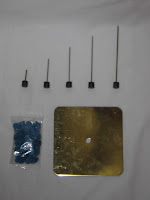
MYM is a toy with parts composed of reused material including: rubber disks, metal rods, metal surfaces, magnets (Fig.1) and even the box it comes in which is made of cardboard. Imagination and creativity of the user is needed in order to construct a final outcome. Even then, one can add to it. Convenient size and collapsible, transportation and storage is at ease.
It is a toy that would be played when one is bored, or when one has the craving to think or build. Schools are able to have it as a playtime toy meaning kids could learn while playing.

Fig.1


Procedure:

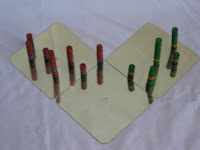
There are a few ways someone can play with MYM. By putting the metal surfaces on another surface. The metal rods that are included, have magnet bases that are then put onto the surface. Also all the surfaces don't need to be used, only one, or all four. The colored disks that come in bags, are used to make patterns, images, or objects by sliding them down the rods. It is possible to make either 2D or 3D outcomes, and the metal surfaces are mirrors (Fig.2), so one can some how incorporate that into what their making. 

Fig.2


Why is it fun?

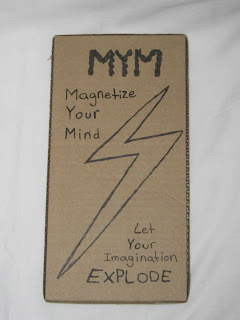
There are very little limitations with MYM and you are not told what to build, you do what you want to do. Once someone starts playing around, they will be reminded of their childhood when they used to build with blocks, or Lego (research showed that users enjoyed interacting with toys that brought back memories of their childhood). This toy takes time to play and once with the end result, one feels satisfaction with what they made. It's not fuzzy, it's not soft, but the nature of a magnet makes it all okay. The intended use of this product does not necessarily have to happen, the magnets alone can be played with separate from the other pieces included. There are many ways to enjoy this toy. A lot of people, mostly younger kids, get "scared" once they open up a box, and a list of instructions fall out. With MYM there are instructions pasted on the inside where it lists the parts, 3 small steps, and 3 examples. The limited explanation makes it less boring, along with the examples that come within, give excitement because they would know instantly what to expect (Fig.3). MYM is so open, that eventually a user is capable to come up with their own game using the pieces.
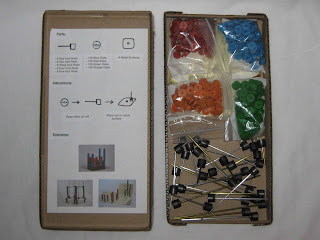

Fig.3


Demographic:

When designing this product, the target consumer was for 17-21 years of age. The end result is acceptable for 11+ years of age and for both male and female users. Since there are little pieces (the rubber disks) and the rods, users under the age of 11 should not play with it unless under adult supervision. The simple "building block" focus of MYM is the attraction of this toy for this age group. With the younger consumer, it would be interesting to see how they interact with it at first since their minds are less influenced from the world around them and have more curiosity in how something works. One could predict that they would play with the magnets more and as they get older, other outcomes using all the pieces included will be made into forms never thought of before. Unlike an older (young adult) consumer who would most likely start building with all the material.

The little limitations of every aspect of the toy including what it's made of, MYM would appeal to those who like to work with their hands and even then it could branch off to many other kinds of people who may not.

This toy can be sold in a variety of outlets including design stores (Umbra), toy stores (Toys R Us) and games stores (Mind Games) where all age groups are bound to come upon this product.


User Testing:

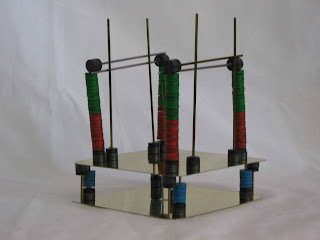
More and more outcomes keep coming from MYM. A female tester, age 18, started off playing around with patterns, adding disks to the rods. Afterwards instead of making another pattern or image, she took the metal surfaces and built vertically using the magnets to hold it together (Fig.4). Along with another tester, age 12 male, they commented that there should be more disks with more colors and more rods of the sizes included. That way there isn't a tendency to run out and more patterns or images can be produced. Other user testers, ages ranging from 17-26 both male and female, had concentrated hard on what they were making but used it in the way it's initially intended.

Because of the simplicity of the toy, the instructions were not needed for 2 of 6 testers. The other 4, once opened the box, automatically looked at the instructions but not for long since they are straight forward. 

Fig.4

Project Two - Final Toy Proposal - Charles Gao

Custom Manga Character kits


Concept:

Majority of Male Manga characters get a similar head shape.
The difference between them is their expression, which is rather drawn on a flat surface.


The concept of this toy is a kit which can be used to create majority of manga characters.

• As shown on picture above, Majority of male characters share a very similar head shape. Majority of female characters share a similar head shape. Similar for boy characters and girl characters.
• By manipulating their hair style, clothes, redraw their expression. One character can be easily transformed to another one completely.

So, What’s a basic kit composed of?
• A removable head which people can “paint” on and repaint easily.
• removable hairs in different hair styles and colors.
• One body with basic clothes on.

Different clothes, backpack, glasses, pets, headphones, Shoes, Scarf, Hat, facial hair, bodies, and much more can be sold separately as accessories.

It can be used to create currently existed characters or characters from imagination.

User testing:


A prototype with paintable hairs and head is constructed to get feedbacks.
By observation, some people like to try to paint the hair but get bored after a while without finish it. No one tried to paint the head itself.
The result shows that people like to try it but do not have patient to finish it up. Reason for the result is probably because of the complicate nature of painting process itself. Nowadays people have so much pressure on them and therefore lack of concentration and patient in “playing”. People rather like to see the instant result and direct feedback, instead of wasting time on painting and cleaning afterwards. Direct feedback will also invite people to take actions.

Improvement:
Based on the result from user testing, the major improvement from prototype is to completely remove the painting process.

How can it be achieved?
1: All the hairs are preprinted already, so there is no painting required on the hairs.
2: Incorporate technology from PC drawing tablet. Make the 3D head a pressure sensitive screen. User can use special pen to “draw” the expression on the face and use the back of pen to “erase”.

3: Surface is special treated to give a frosted feel, so that it is inviting people to touch and make it easier to draw on.

Why the toy is fun?

This toy is actually combined many factors of fun together.
l It is made of interesting material. (Soft plastic for hairs and frosted feel of head).
l Different bright colors are used together to make it more eye catching and more fun to look at.
l This toy can be highly customized; different accessories are available to create a unique toy for each user. Therefore fit a variety of personas.
l The fact that people can trigger an action and get a direct response creates confidence and invites people to do more with the toy.
l The toy is very cute.
l This toy is highly poseable, people can use it to create different characters in different settings or “fool around” to create silly poses or expressions.
l Last and most importantly, for people who love manga, it is definitely a toy for them. Recreate famous characters can bring them back to the memory of the manga story. By creating the character of their own, they can fulfill their dream as a manga character designer.


How it works?


Target consumer and Marketing Strategy:

This product is a perfect choice for manga lovers. However, many other people may love it because the fact that it can be highly customized to special looks which fit different personas. Therefore the target of this product can be ranged from 6 year old to young adult. Since it gets many small parts, it may not suitable for children below 6 years old.

This custom kit will be sold as follows:
One basic kit contains a removable head to “draw” on, 3 common hair styles with different color, a body with jeans and jacket on and finally a digital pen for “drawing “and “erasing”.

Accessories can be sold as kits also.
l Kit to create completely new characters form imagination. For example: urban outfitter kit which contains different urban clothes, hair style, headphones, shoes, and backpack etc.
l Or, kit to recreate a well-known manga character. For example: dragon ball kit which contains different hair styles, clothes of Goku in different sittings.

Monday, March 2, 2009

Experience with i Movie by Jay Oh


By: Jay oh

Project Two - Final Toy Proposal - Lindsay Sinclair


MAGNART:
Interactive Geometric Fridge Art


WHAT IS IT?

Magnart is a set of colorful, magnetic, geometric shaped blocks that fit together in an endless combination of ways. The blocks can be manipulated to create various forms of artwork from mindless abstract arrangements to complex geometric patterns and everything in between. These blocks are very easy to use and people of all age groups will be attracted to them whether they are creative or not. The artwork that is created through arranging the shapes becomes a form of decoration on your kitchen that is impernanent but nonetheless a way to showcase a creative expression without the pressure of it being permanent. User testing showed that individual people were drawn different colors and so Magnart comes in a variety of color schemes to suit your style or to match your kitchen. Multiple people can collaborate on a desisn together, and people of all ages can use Magnart. These simple blocks will bring you back to grade school yet they can produce sophisticated patterns and hip geometric designs.


DEMOGRAPHIC:


The toy has been designed with young adults in mind, although it could just as easily be a toy for children and youth given the simplicity of the concept and the ease of use. Young children can arrange more rudimentary compositions that evolve in complexity as they get older. The ideal user is between 18 and 35 years old and is visually focused, whether that mean artistically inclined or just interested in the visual realm of their environment. Magnart is intended to be sold in design stores as well as larger urban culture focused stores such as Urban Outfitters. The product appeals to young adults with a soft spot for nostalgic decorations.

WHY IS IT FUN?

People are drawn to this toy because it makes them nostalgic for their childhood when simple toys entertained their imaginations for hours. Creative and non-creative people alike will find it easy to create interesting patterns and the possibilities are vast. The shapes themselves are colorful, soft and pleasing to touch. They are pleasing to the touch and can easily be slid, picked up and manipulated. Adults will find them to be enjoyable because they provide a justifiable excuse to play with blocks given they function as decoration on your fridge. They provide an outlet for people who don't create very much visual decoration of their own and they are accessible to those who shy away from creating things because they assume they are not good artists. There is a motivation to interact with the shapes because they are viewed often and can so easily be altered to suit individual styles and kitchens.


Project 2-Final Toy proposal-Cathy Lai


Target consumers: Any kind (people who enjoy drawing and decorating their houses)

Project 2 - Final Toy Proposal- Joshua Frechette


The OCADoll
The newest craze at OCAD!!!!
And if we're doing it, you know it's cool!

The OCADoll, and why you, the new OCAD student, should have one...
Welcome to OCAD! We know your fist year at university can be hard, and it's not always easy to make new friends...so why not buy one? ( Sort of) The OCADoll is perfect for you! The OCADoll can be personalized to your personal tastes, and can even be outfitted with accessories inspired from your program! Have hours of fun customizing yours and proudly show off your creative side! Literally!

How does it work?
Each OCASDoll package comes comes in either male or female, with standard detachable body parts. A mix of addtional, random body parts is also provided (two pairs of arms, two heads and two bottoms). Additional body parts are available separetely. Also included is a cellphone, iPod with headphones, energy drink, coffee, watch, and sunglasses. Further customize your OCADoll with "Program Packs", which are a collection of accessories that incorporate actual materials used in OCAD programs! (e.g. For a design student, the kit would include a Macbook, typography stencil, a finished poster, etc...)

Demograhic projections and research
This product is aimed at university students, and, for this version, specifically OCAD students. Ultimately, 18-25 years olds of either gender who wish to have an original product that reflects themselves and their school. The interchageability and accessories allow the product to appeal to a large percentage of the student body. This product my also appeal to alumni and may also find a market outside of OCAD. It was during in class product testing that I noticed that people were moving the head and arms around, an unexpected result due to my inability to resolve keeping a range of motion of these parts. Based on these observations, I decided that the doll would have interchangeable and less realistic body parts, to keep it interesting. It was also suggested that I make the doll's identity more cohesive and comprehensive, thus the initial, standard package and then subsequent kits that can be bought seperately.
Why is the OCADoll fun?
The OCADoll provides students with the chance to express themselves in ways that they may not be able to under normal circumstances; it provides them the fantasy of "being" a doll, in that they can look however they want and have whatever they want. It also helps them identify more with being a student at OCAD and with their program. By buying new kits and body part packs, the variations are endless for the OCADoll!

What does the future hold for the OCADoll?
World domination, of course....the OCADoll line, if initially successful, could include teacher dolls, which would reflect their programs much like the student do. Eventually, sets could be released that could include classrooms ( with chalkboard,tablers, etc...), the park( with hackysack, skateboard, etc... and a room in residence ( with a bed, desk, etc...).

Toy Final Proposal by Jay Oh


By Jay Oh
Wired-pen: "Make your own doodle"


Why is "Wired-Pen" fun?
It keeps you out of from boring situation,
such as in class, office, home, and even while listening to the music

Target consumer?
"Wired-Pen" product is for group age between Teenagers to Adults, since they can be more bored with their life, but the product can be also for kids, because it can develope the childrens creative and imagination.

Sunday, March 1, 2009

Toy Pitch


America’s Sweetheart

America’s Sweetheart is the perfect parody gift for all you friends. Every guy wants the perfect girl and every girl strives to be the perfect girl. America’s Sweetheart is exactly that, she is society’s rendition of perfection in the form of a playful doll. Her overworked face and adjustable body size are a social commentary on the social constructions mass media has developed for us to fit into. Everyone in agreement with these ideas will love this doll because who doesn’t love to poke fun at fake people with botched botox
and badly done face lifts.

America’s Sweetheart is and interactive toy. Included are three faces through the process of her plastic surgery from pre-op. to post-op. Also, she comes with three different hairstyles to go with her various faces. Furthermore, her bust and waste line are adjustable indicating liposuction and breast implants. America’s Sweetheart turns from the average girl into the plastic surgery monster woman like so many others women we have seen in the media.

Through ethnographic research on ‘what is fun?’ it has been discovered that people of this demographic (university students) find things that remind us of our childhood are things we seem to have the most fun with. This toy is a throwback to our old Barbie dolls, the ones that would not be able to function properly or stand up for that matter if they were actually a real woman. Becoming the perfect woman has come to creating something that is completely implausible in the physical world. We all know of these things so why not make fun of them through a cute little doll.

When watching people play with America’s Sweetheart they seemed to be enjoying her and poking fun at the faces that she comes with. They enjoyed the interactivity of the doll with the changeable pieces. Some improvements that were suggested were to make her larger (approximately 14 inches) and for her to actually have an adjustable waist and bust line (these features were not included in the mock up).

America’s Sweetheart is the perfect girl for everyone to enjoy!


(not recommended for children)

Project 2 - Final Toy Proposal (Guitar Puzzle) - Joe Lee

*GUITAR SMASHING PUZZLE*
Smash Like A Rock Star
by Joe Lee


After a test user of the guitar puzzle experiment on a few colleagues, the feedback I have gotten from the user testing that some user said they would prefer some graphic on the guitar because the prototype was a full plain color was hard to figure out which one was the right piece for the certain part of the guitar. The other said that the guitar puzzle without the graphic was challenging for them to make them think a lot.

The other purpose that they did not aware of that the guitar is smash able to allow the pieces from the guitar body to break apart and they can be put back together like a puzzle as shown below.


___________________________________________________________________
HOW IT WORKS

Basically, it is just like a guitar hero controller but you are playing a real size of an electric guitar. While playing guitar hero or not, you could smash that guitar and the pieces will fall apart. Not to worry, you can put it back together with ease.


My final proposal of the prototype is the guitar puzzle controller for the Guitar Hero & Rock Band, the music games. The guitar controller remained the way it is as the buttons, the strum bar, and the whammy bar, but the body of the guitar will have 2 different layers. The first layer of the bottom will the base which will be made of polycarbonate, which feature temperature resistance, and impact resistance. This material is chosen because it the durability against the force impact. Each pieces will have a different directions of the interlocking joint, located at the bottom surface of the 1st layer, and each bottom will have the hole for the other joint for the 2nd layer of the body guitar.


The second layer of the body is the replicate pieces puzzle of the body guitar for smashing. The second layer is also made of polycarbonate because of its durability against the force impact when it forcefully hit on the surface. The 2nd layer will have the interlocking joint just like the puzzle to allow the 1st layer pieces to join back together.

Secondly, the size of the guitar will not be the size from the Guitar Hero, it will be the real size of the real electric guitars, particularly for adult player. Guitar manufacture brand like Peavey first created a real size guitar controller from the existing electric guitar.

My proposal will be the combination of Guitar Hero & Rock Band guitar controller, with Peavey’s remake of the guitar controller from the real guitar, and my invention of guitar puzzle that allow players to smash their guitar and allow them to put the pieces back together.

DEMOGRAPHIC

The target consumer of the product are the group age in between young adults to adults who like to music and games like Guitar Hero & Rock Band.

I think it is also suitable for adults who need some relaxation from their daily work. Some adults like to play guitar hero as well so they can release their stress by playfully smashing their guitar puzzle in a happy way like my partner's feedback based on the Jordan/Tiger physio-pleasure: a person would really appreciate the feeling of crashing while playing Guitar Hero or not.

WHY IS IT FUN?

It is fun because by selling this toy, consumers can do something that they wanted like smashing the guitar and be like a rock star. Without this toy, people tend to smash either the real electric guitar or the guitar hero controller, but once they broke, they can't be repaired or put back together so that is considered a waste of money.

It also creates the hands and eye coordination, allow people to think, looking at the piece in order to find the right slot of that piece. It will be more challenging if the guitar puzzle has no graphic, just simply plain color.

And finally, it is fun when you completely finishing putting back the pieces where they belong, you will feel the sense of accomplishment.

Therefore smashing a guitar and putting back together can have the feeling of fun and doesn't have to worry whether it's going to break or not.

____________________________________________________________________


Project 2 - Final Toy Proposal - Katie Goulet


Story in a Book - The game for everyone and anyone to enjoy!

Story in a Book is a fun activity that can be modified to work for almost any age group. Although the object appears to be only a book, when opened, one will find that there is no story inside, but rather a strange combination of objects.

How it works:

The first "player" reaches into the book without looking and pulls out an object. They must begin a story using this object as the subject, and are only allowed to say four lines of story. The next player does the same thing, only this time they must continue the previous story line with their new object. This continues until the book is empty, or players can choose to put their object back in once it is empty and re-pull them out, providing that they do not repeat an already said event or idea.


Demographic:

Story in a Book can be modified, simply by changing the objects on the inside. The first version of Story in a Book contained characters and objects that catered to a much younger audience, with fairy-tale like objects, like a princess hat, magic wand, and a dragon like creature. After user testing with people between the ages of 18 and 25, it was determined that  a much more random and mature set of objects could be placed inside, and this would allow the story lines to become more interesting, humorous and all around entertaining. The new object package now contains things like a small red recliner chair, a fetus, and a sweatshirt.


Why is it fun?

Story in a Book was also tested on younger kids, between the ages of 6 and 10 and all really enjoyed the creative aspect, and that they could make up their own bedtime story.
The concept of Story in a Book is to allow anyone who chooses to play to simply be creative and imaginative without the help and restrictions of familiar characters and scenarios. The possibilities of stories are endless and can be renewed simply by choosing another package of objects, or by putting your own found objects into the book.
Story in a Book is a great game for small children to use their ever-expanding imaginations and proves to be an excellent party game for people of all ages, where the scenarios and story lines become completely ridiculous and creative. 
Story in a Book also pushes adults to be more creative, as many of us often lose that simple imaginative way that we once were as children, and this is a small window of opportunity for us to re-experience it and possible re-gain it.

Story in a Book - Future Possibilities
To keep Story in a Book fun and exciting, as well as culturally relevant, the makers will 
continue to produce new packages of objects with the possibility of creating themed packages as well as random mixes

.